Genovese basil
Tender Basilico Genovese leaves provide the defining perfume. The DOP designation protects basil grown and handled under Ligurian production rules; it does not make the finished pesto a DOP product.
Italian sauce guide
A method of crushing ingredients into sauce—and a name inseparable from Liguria’s basil-rich Pesto Genovese.
Understand Genovese pesto →The essential idea
The Italian word pesto is related to pestare—to pound or crush—and can describe a mixture made by pounding ingredients together. In its most culturally specific sense, however, it means the Ligurian condiment Pesto Genovese.
That distinction matters. A sauce of blended basil, cashews, and neutral oil may use a pesto-like method, but it does not share the ingredients or regional identity of Pesto Genovese. Conversely, not every Italian pounded sauce is green or basil-based. “Pesto” is a useful family name only when the particular sauce is also identified clearly.
Liguria & Genoa
Crushed herb, garlic, cheese, and nut mixtures have older precedents, but drawing a straight line from ancient Roman moretum to modern pesto is interpretation, not proof of an unchanged recipe. A firmer documentary point is Giovanni Battista Ratto’s La Cuciniera Genovese, first published in 1863, which helped codify Genoese cooking and included an early written form of the basil-and-garlic sauce.
Today Pesto Genovese is one of Liguria’s defining foods. Basilico Genovese received European DOP protection for its geographical origin and production method. The basil is protected; the finished pesto itself is not a DOP product, and recipes still vary in proportion and handling.
Traditional composition
Authoritative Ligurian descriptions consistently center basil, pine nuts, garlic, extra-virgin olive oil, hard cheeses, and salt. Balance—not maximum intensity from any one ingredient—is the goal.
Tender Basilico Genovese leaves provide the defining perfume. The DOP designation protects basil grown and handled under Ligurian production rules; it does not make the finished pesto a DOP product.
Pine nuts contribute a mild nuttiness and soft body without competing heavily with the basil. They help turn crushed leaves, garlic, cheese, and oil into a cohesive paste.
Garlic supplies pungency and sea salt seasons while helping the pestle break down the ingredients. Their force should support the basil rather than obscure it.
Olive oil carries aromatic compounds and loosens the crushed paste. Ligurian tradition favors a delicate oil that does not dominate the basil.
Aged cow’s-milk cheese adds sweetness, savoriness, and body. Its salt level and maturity affect how much additional seasoning the pesto needs.
Traditional accounts commonly include Pecorino, often Fiore Sardo, beside Parmigiano. Its sharper sheep’s-milk character gives the blend definition, so balance matters.
Mortar method
A marble mortar and wooden pestle bruise and grind rather than slice. Work efficiently so the basil stays aromatic and the ingredients become creamy without warming excessively.
Crush them against the mortar wall into an even base. This removes hard pieces before the delicate leaves enter.
Work a small handful at a time with a rotating motion along the wall. Crushing, rather than chopping, expresses the leaves into the paste.
Blend the grated cheeses into the basil base and judge salt only after they are integrated.
Add enough oil to loosen the paste without turning it greasy. The finished texture should remain creamy and spoonable.
Use small additions of warm pasta water to make a fluid emulsion, then toss away from direct high heat.
Modern equipment
It can make a useful pesto, but its cutting action is not traditionally equivalent to grinding with a pestle.
Start with cool, thoroughly dry basil and avoid a warm machine bowl. Temperature control protects aroma and slows discoloration.
Short pulses limit friction and let you monitor texture. Scrape the bowl between pulses instead of processing until perfectly smooth.
Blend the solid ingredients first, then incorporate oil briefly. Prolonged high-speed mixing can create heat and an overly uniform texture.
A machine-made sauce can follow the Genovese ingredient tradition while remaining a modern preparation method. There is no need to pretend the tools produce identical results.
Handling & finish
Pesto is already a finished raw sauce. The goal is to warm it with pasta, not fry it in the pan.
Cut basil darkens through oxidation. Work promptly, limit unnecessary air exposure, and cover before refrigerating.
The mortar produces a creamy paste with character; machine processing should stop before it becomes hot and completely uniform.
Salt helps grinding, but both cheeses add more. Judge the diluted pesto rather than the concentrated paste alone.
Hot pasta provides enough warmth. Strong direct heat drives off basil aroma and can split cheese from oil.
Before draining, stir a small amount of warm pasta water into the pesto. Add the hot pasta away from direct heat and toss, adding more water only as needed. Starch and water disperse the cheese and oil into a supple coating; too much water at once makes the sauce thin rather than emulsified.
Pasta pairing
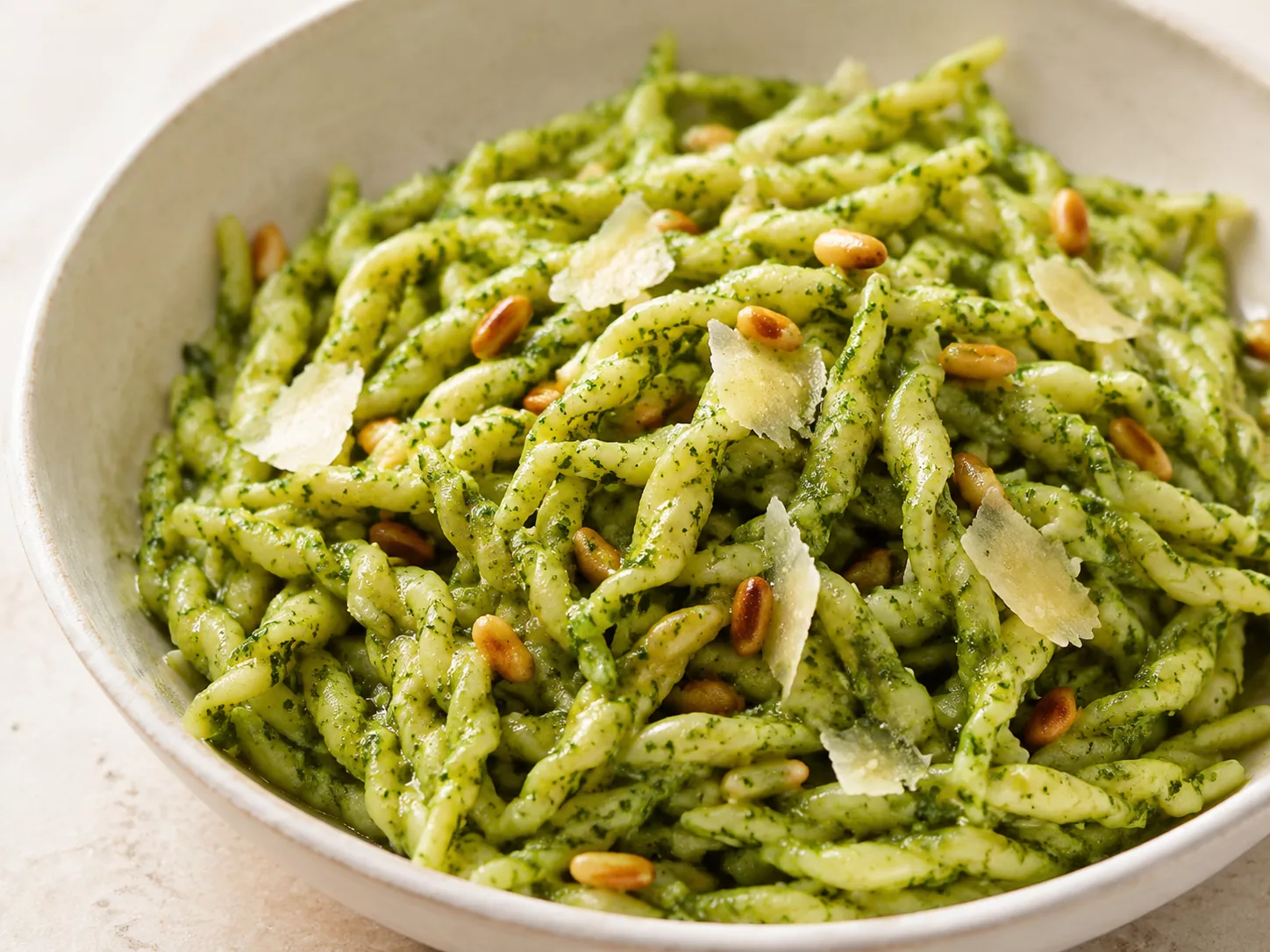
Trofie and trenette are the regional reference points. Other shapes work when their surface and scale suit a finely crushed, clingy sauce.
Short twists create channels and friction for pesto; their firm, compact bite stands up to the dense aromatic sauce.
↓ TrenetteLigurian classicLong, narrow Ligurian strands offer broad contact for an even green coating and are traditionally served with pesto.
↓ SpaghettiLong alternativeA properly loosened pesto can coat solid strands continuously, though spaghetti is not as regionally specific as trenette.
→ FarfalleFolds & wingsThe broad wings carry a fine coating while the pinched centers and pleats gather small flecks and green beans.
→ OrecchietteUseful with piecesThe cups suit pesto accompanied by small potato cubes or green beans; very thick undiluted pesto can collect too heavily.
→At the Ligurian table
In well-established Ligurian preparations, trenette or trofie may be served with pesto, potatoes, and green beans. The vegetables are not ingredients pounded into Pesto Genovese; they cook with or alongside the pasta and become part of the finished dish.
Potato contributes soft starch and green beans add a fresh, firm contrast. Their presence is traditional, but not compulsory every time pesto is served. Gnocchi and Ligurian filled or fresh pastas also have their own local pesto pairings.
Beyond Genoa
Crushing herbs, nuts, cheese, and oil is a productive framework. Clear naming preserves the difference between adaptation and regional tradition.
A distinct western Sicilian sauce built around tomatoes, almonds, garlic, basil, and cheese. Its history and proportions belong to Trapani, not to the Genovese formula.
Especially associated with Sicilian pistachio cooking, this family may combine pistachios with oil, cheese, herbs, or citrus. It should be named for what it contains.
Rocket, parsley, kale, and other greens can be crushed with nuts, cheese, and oil using a pesto-like method. They are useful variations, but not Pesto Genovese.
Salsa di noci is another important Ligurian pounded sauce, traditionally associated with filled pasta such as pansoti. Its walnut and dairy character deserves its own name.
Common mistakes
Heat, overprocessing, and unmeasured dilution can flatten a sauce whose appeal depends on fresh aroma and controlled texture.
Direct heat dulls fresh basil aroma and can make cheese and oil separate. Loosen the pesto, remove the pan from strong heat, and toss with hot pasta.
Continuous high-speed blending warms and overworks the mixture. With a machine, use short pulses and stop while the sauce still has fine texture.
Parmigiano and Pecorino contribute significant salt. Build the paste, dilute a spoonful as it will be served, then decide whether it needs more.
Undiluted pesto sits in clumps and can feel oily. Pasta water changes it into a coating that travels across the chosen shape.
Food safety
Homemade pesto combines low-acid fresh herbs and garlic with oil, so it must not be stored at room temperature. The National Center for Home Food Preservation advises refrigerating freshly made pesto for no more than three days or freezing it for longer storage.
Use a clean covered container, label it with the preparation date, and freeze portions you will not use within that window. There is no recommended home-canning process for pesto; this page does not provide shelf-stable preservation instructions.
Put technique into practice
Follow a mortar-first editorial recipe that loosens pesto with warm cooking water and mixes it with pasta away from direct heat.
Open the recipe →Compare pasta shapes →Editorial draft — PastaBible kitchen testing still required.