01Puglian classic
Cime di rapa
Chopped turnip greens settle into the hollows while olive oil, garlic, anchovy, and chilli coat the rough surface.
Pasta shape guide
oh-rek-KYEH-teh · orecchietta, “little ear”
Small, concave rounds with a thin center, a substantial rim, and a rough exterior. Each piece behaves like a tiny scoop, collecting chopped greens, crumbled sausage, beans, and textured sauces.
Find the right sauce →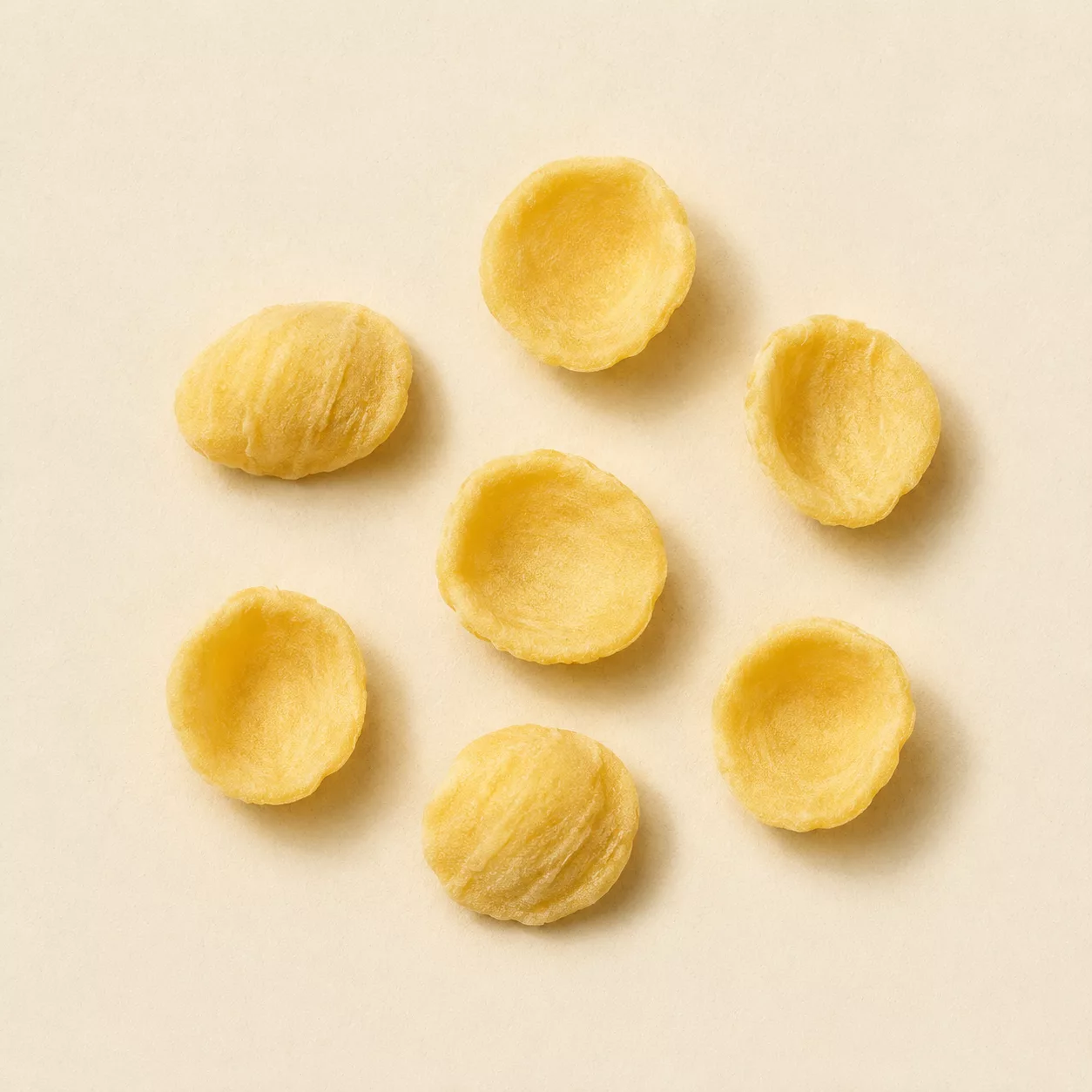
Name & identity
Orecchiette is the plural of orecchietta, a diminutive of the Italian word for ear. The resemblance is structural as well as visual: every piece has a shallow hollow surrounded by a thicker, curved edge.
Orecchiette are deeply identified with Puglia, particularly the area around Bari, and are also part of the handmade-pasta culture of neighboring Basilicata. Their precise beginnings are difficult to document, so it is safer to understand them as a long-established southern Italian tradition than to assign a single inventor or certain date.
Scoops up greens, beans, crumbs, and small pieces of sauce
Provides a textured surface to which oil and sauce can cling
Gives each small piece a firm, satisfying chew
Made by hand
Traditional dough is made from durum wheat semolina and water. A narrow rope is cut into small pieces; each piece is dragged against a board with a table knife, creating a textured curl, then opened or turned over a fingertip so the center becomes hollow and the rim stands proud.
The shaping motion creates the sauce-catching surface: a thin cup inside, a rough dome outside, and a chewy edge around both.
Sauce pairing
Think in small pieces. The best partners can sit inside the cups or cling to their rough exterior without filling the bowl with oversized chunks.
Chopped turnip greens settle into the hollows while olive oil, garlic, anchovy, and chilli coat the rough surface.
Crumbled sausage and chopped broccoli rabe or other bitter greens match the scale of the cups and contrast their firm bite.
A moderately chunky tomato sauce with peas, aubergine, courgette, or broccoli gives every hollow something to carry.
Flaked fish, small shellfish, capers, and a light oil- or tomato-based sauce fit the shape without masking its texture.
Signature pairing
Puglia’s defining orecchiette dish combines the pasta with turnip greens, extra-virgin olive oil, garlic, chilli, and often anchovy. The greens are cut small enough to enter the hollows, so the shape and condiment arrive together in each bite.
Know the difference
Look for a true cup, the thickness of its rim, and whether the surface was dragged by hand or formed through a die.
| Shape | Form | Surface | Best uses |
|---|---|---|---|
| Orecchiette | Small concave disc with a thick rim | Rough outside, smoother hollow | Greens, sausage, vegetables, legumes |
| Cavatelli | Elongated shell or hollowed dumpling | Usually smooth or lightly ridged | Rustic vegetable and meat sauces |
| Strascinati | Broader dragged pasta with an open curve | Textured by the shaping board | Southern Italian ragù and vegetables |
| Conchiglie | Extruded shell with a deeper cavity | Often ridged | Tomato, cheese, and baked dishes |
| Gnocchetti sardi | Small ridged oval dumpling | Deep external grooves | Sausage, tomato, and substantial sauces |
Technique
Fresh handmade and dried orecchiette cook differently. Use the package time only as a starting point and taste the thick rim.
Shake away loose semolina and check that no cups are nested together; stacked pieces can remain hard where they overlap.
The hollow pieces can sit inside one another or cling to the pot. An early, gentle stir keeps water moving between them.
The center is thinner than the curved edge. Judge doneness at the thickest point and look for a firm chew without a raw, floury core.
For cime di rapa, cooking the greens and pasta in the same seasoned water helps bring their flavors together; timing depends on the tenderness of the greens and whether the pasta is fresh or dried.
Transfer to the pan with some cooking water and toss until glossy. Too much thin liquid leaves the pieces swimming instead of carrying the condiment.
Common mistakes
Nesting is the shape’s main hazard. Stir early, avoid overcrowding, and separate handmade pieces before boiling. Do not assume that floating alone proves fresh orecchiette are ready; thickness varies, so taste one of the heavier rims.
Cut the condiment to the scale of the cup: if every piece is too large to enter the hollow, the shape cannot do its job.