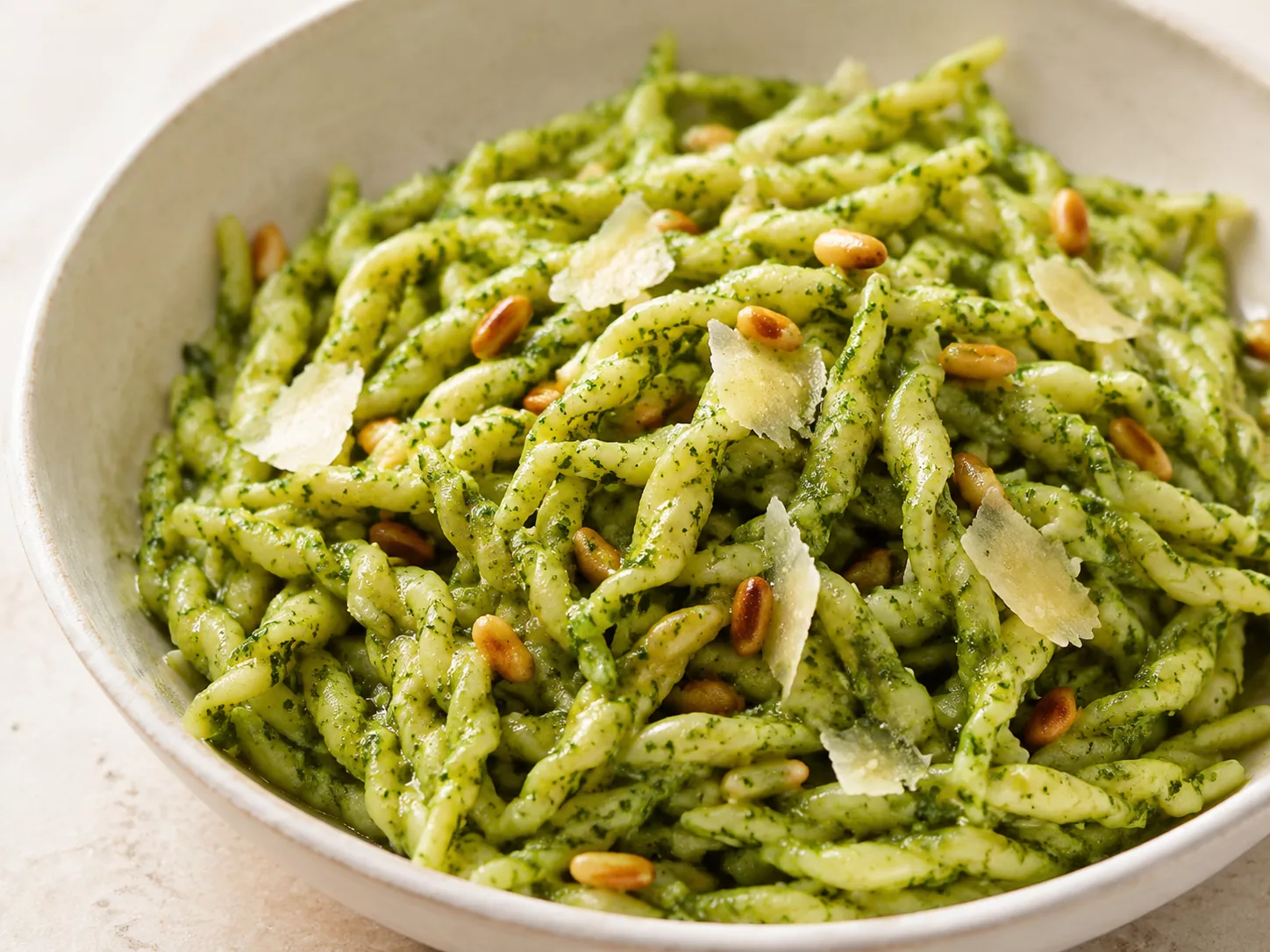
Green and creamy with fine leaf texture. The oil is incorporated rather than sitting as a clear layer underneath.
Pasta recipe
Pasta with
Pesto Genovese
Short twisted pasta dressed off heat with basil, pine nuts, garlic, two cheeses, olive oil, and just enough cooking water to make the pesto flow.
Editorial draftThis recipe has not yet been kitchen-tested by PastaBible.
The version here
Trofie first, with room for other shapes
This PastaBible draft uses dried trofie as its primary pasta: the compact Ligurian twists provide abundant surface and channels for a finely crushed sauce. Trofie is a regional reference point, but it is not the only valid pasta served with Pesto Genovese; trenette, mandilli, gnocchi, and other local forms also appear in Ligurian practice.
Among current PastaBible guides, farfalle catches pesto in its folds, orecchiette works especially well when vegetables accompany the sauce, and properly loosened pesto can coat spaghetti. These are practical alternatives, not claims that every shape has the same regional standing as trofie or trenette.
Method
Crush cool, loosen warm
The mortar builds the paste; warm cooking water turns it into sauce. Direct burner heat is not part of the finish.
- 01
Prepare a cool, dry workspace
5 minWash the basil briefly and dry every leaf thoroughly; surface water weakens the pesto and encourages discoloration. Finely grate 45 g (1.6 oz) Parmigiano and 20 g (0.7 oz) pecorino. Keep the basil out of direct sun and do not warm the olive oil.
- 02
Make the garlic-and-nut base
2 minPut the 4 g garlic clove, all 30 g (1.1 oz) pine nuts, and 3 g (1/2 tsp) coarse salt in a marble mortar. Pound and grind against the wall until no hard pieces remain and the mixture resembles a thick cream.
- 03
Crush in the basil gradually
5–7 minAdd the 60 g (2.1 oz) dry basil a small handful at a time. Press and rotate the pestle along the mortar wall, gathering the leaves back toward the center. Work efficiently rather than pounding for a long time; stop when the leaves form a fragrant green paste with fine texture.
- 04
Finish the Pesto Genovese
2 minWork in all 45 g (1.6 oz) Parmigiano and 20 g (0.7 oz) pecorino. Stir in the 80 ml (1/3 cup) olive oil gradually with a spoon until the pesto is creamy and cohesive, with no pool of oil beneath it. Cover and keep at cool room temperature while the pasta cooks; do not heat it.
- 05
Cook the trofie
Package timeBring 3 L (3 qt) water to a boil and dissolve in all 15 g (2 1/2 tsp) fine salt. Add 320 g (11.3 oz) dried trofie and stir. Cook to a resilient al dente texture, following the package as a starting point and tasting before its stated time. Before draining, reserve 360 ml (1 1/2 cups) cooking water.
- 06
Loosen the pesto off direct heat
1 minPut the pesto in a large serving bowl away from the burner. Whisk in 120 ml (1/2 cup) warm pasta water in three additions. It should change from a dense paste to a creamy, fluid sauce; if the bowl is very cold, warm it first with hot water, then dry it completely.
- 07
Toss and serve immediately
1–2 minDrain the trofie and add it directly to the loosened pesto. Toss energetically, adding up to another 120 ml (1/2 cup) reserved water 15–30 ml (1–2 tbsp) at a time. Stop when every twist is coated and no oil collects at the bottom. Taste before adding any salt: the cheeses, mortar salt, and cooking water are already seasoned.
Kitchen checkpoints
What to see and feel
Firm through the center without a hard floury core. The twists remain separate rather than collapsing into a sticky mass.
Fluid enough to coat every piece, but not watery. A spoonful leaves a green film on the bowl with no oily puddle.
Failure points
Keep pesto fresh and cohesive
The pesto turns dark
Wet leaves, slow processing, warmth, and air exposure accelerate discoloration. Dry the basil, work efficiently, cover the finished pesto, and mix it close to serving.
The sauce looks oily
The pesto needs water and agitation. Off heat, add 15 ml (1 tbsp) warm pasta water and toss firmly; repeat only until the oil disperses.
The cheese becomes stringy
The bowl or pasta was exposed to excessive direct heat. Move away from the burner and add a little warm—not boiling—water while tossing.
The dish tastes too salty
Do not season the finished bowl automatically. Both cheeses and two measured additions of salt are already present; taste only after the pesto is diluted and attached to pasta.
Ligurian preparation
Add potatoes and green beans accurately
Use the same cooking pot
Add all 200 g (7 oz) potato cubes to the boiling salted water 5 minutes before the dried trofie. Add all 150 g (5.3 oz) green beans when the pasta has about 5 minutes left. Taste each component: the potato should be tender, the beans cooked but still structured, and the trofie al dente.
Keep the pesto unchanged
Reserve the same 360 ml (1½ cups) cooking water, then drain the pasta and vegetables together. Toss all three with the pesto off heat, using water gradually. Potatoes and green beans belong to the composed dish, not inside the mortar.
If you use a machine
A small chopper is a modern adaptation, not the traditional equivalent of a mortar. Keep the dry basil and bowl cool, pulse garlic and nuts first, pulse in basil briefly, then stir in cheeses and oil by hand. Do not run the motor continuously until the sauce heats.
Storage
Make fresh or freeze the pesto
The National Center for Home Food Preservation advises keeping freshly made pesto refrigerated for no more than three days, or freezing it for longer storage. Refrigerate promptly in a clean covered container; do not keep homemade herb-and-garlic pesto at room temperature and do not home-can it.
Once mixed with pasta, quality declines quickly because the pasta absorbs water and the emulsion tightens. Make only what you intend to serve when possible. If you save dressed pasta, refrigerate it promptly and use it within the pesto’s three-day window; serve cool or let it lose its refrigerator chill rather than frying the pesto over high heat.
Explore the connections
Understand the sauce and the shapes
Ingredient quantities, timings, and sensory checkpoints are an editorial working draft. PastaBible has not yet kitchen-tested this recipe; it should be prepared repeatedly before the draft status is removed.