Pasta Bible · Explore Italy
Lazio: Rome’s Pasta Classics & Regional Roots
Several of Rome’s best-known pasta dishes use a short list of assertive ingredients, yet they are not interchangeable. Cheese and pepper, rendered cured-pork fat, tomato, and egg create different sauce structures. Learning those differences is more useful than remembering four famous names without knowing what they promise.
Rome is part of Lazio, and the region is wider than its capital. Amatrice provides an important reference for amatriciana, while pasta traditions extend through other towns and landscapes. Begin with the familiar Roman dishes, but keep place names precise and leave room for local and household variation.
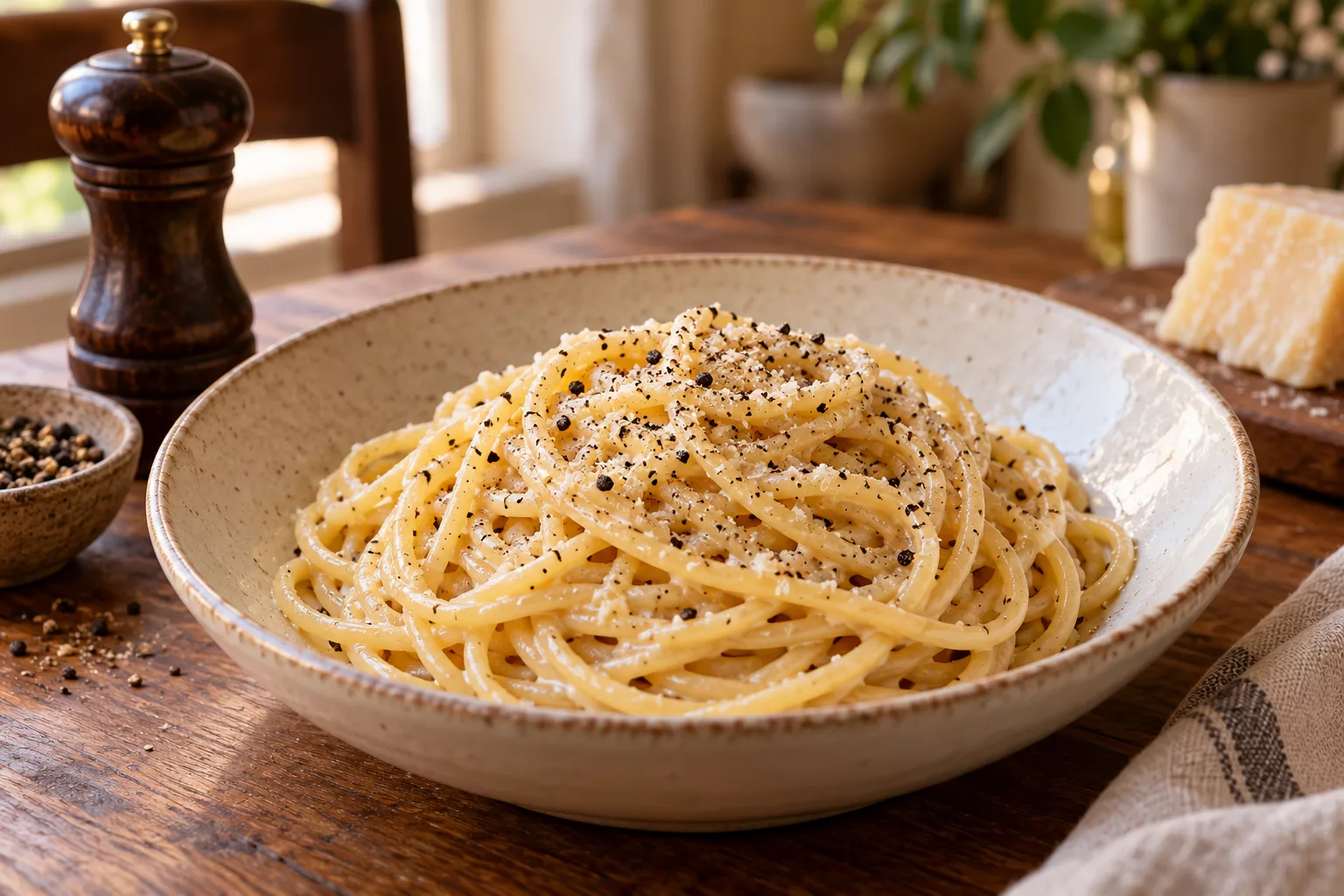
Cacio e pepe: cheese and pepper have nowhere to hide
Cacio e pepe centres on cheese and black pepper, with Pecorino Romano strongly associated with the Roman preparation. The finished dressing should coat the pasta rather than leave dry cheese granules scattered over it. Its apparently simple ingredient list makes the handling of moisture and heat especially noticeable.
For a home cook, this is a reason to prepare carefully, not a promise of an effortless dinner. Finely grating a suitable cheese and understanding the chosen method matter. Follow a complete recipe rather than assuming that a large handful of cheese tossed into very hot noodles will always become smooth.
Our Italian cheese guide explains Pecorino Romano’s sheep’s-milk identity and its difference from other grating cheeses. Its name does not mean that all production is confined to Rome. Do not infer a product’s complete geographical specification from the familiar city association alone.
Gricia: understand the role of guanciale
Gricia brings guanciale together with pecorino and pepper without a tomato sauce. Guanciale is cured pork jowl; it contributes both pieces of meat and rendered fat. It is a distinct product from streaky bacon, and substituting one for the other changes the flavour and often the way the pan behaves.
When ordering gricia, expect a savoury preparation, not a cream sauce simply because the coating looks pale. For cooking, choose a recipe that explains how the pork and its fat join the pasta. Adding unrelated dairy to compensate for an unbalanced finish changes the dish rather than solving every possible technical problem.
Accounts of gricia’s origins differ. The dish can be firmly part of the regional repertoire without requiring one proposed derivation of its name to be treated as settled history. Its ingredients and eating character provide a much sounder starting point.
Amatriciana: remember Amatrice as well as Rome
Amatriciana is strongly associated with Amatrice and is also a familiar Roman pasta dish. Tomato, guanciale, and pecorino distinguish its character. Rome’s association with bucatini all’amatriciana is well established, while other presentations and pasta choices exist.
Bucatini are long hollow strands, not simply unusually thick solid spaghetti. Their structure changes the bite and the way they carry a dressing. Choose the shape deliberately and follow its own cooking guidance rather than treating a sauce name as a cooking time.
At home, keep the tomato and cured pork in balance. A dish does not become more recognisably amatriciana by accumulating extra ingredients. Read the particular recipe you intend to follow, recognise its choices, and distinguish a personal variation from the version it describes.
Carbonara: egg changes the method
Carbonara introduces egg into a dressing associated with guanciale, cheese, and pepper. The familiar Roman style does not depend on cream for its texture. That does not make it identical to cacio e pepe with a little meat added: egg changes both the sauce and the handling requirements.
This article explains the dish’s identity, not a complete carbonara method. Do not use a glossy appearance as proof that an egg preparation is safely cooked. Follow appropriate egg-safety guidance and a reliable complete recipe; a regional name is not a substitute for safe handling and cooking decisions.
Carbonara has competing origin accounts, including twentieth-century explanations. There is no need to select the most entertaining story and present it as certainty. Its current association with Rome is clear enough for understanding a menu without inventing an ancient, uninterrupted recipe history.
Compare the dishes before choosing dinner
If you want the sharp simplicity of cheese and pepper, cacio e pepe provides that focus. Gricia adds cured pork and its fat. Amatriciana brings tomato into the picture. Carbonara changes the dressing with egg. This comparison helps identify the main character of each dish; it is not a recipe chart that makes their methods interchangeable.
Their dietary implications differ too. Guanciale is pork, egg matters to some diners, and traditional pecorino may use animal rennet. A sauce without visible meat may still need ingredient checking for vegetarian suitability. Ask about the actual preparation rather than guessing from its colour.
Season with the whole dish in mind
Cured pork and aged cheese can contribute substantial salt. Taste the combined dish before adding more, and consider the cooking water when planning the sauce. Our salting guide explains why a practical starting point should be adjusted to the ingredients instead of repeated mechanically.
Likewise, adding more cheese is not always the answer to a thin coating, and more fat is not always the answer to a dry one. Read the method for the specific sauce structure. Water, temperature, and movement have different roles when egg, tomato, or cheese is the main binding ingredient.
Explore beyond one Roman shorthand
Lazio’s pasta cannot be exhausted by four famous restaurant dishes. Their prominence makes them useful starting points, but it should not erase the region’s wider fresh-pasta, vegetable, and local cooking traditions. When a menu names a town or an unfamiliar shape, ask what that reference means in the particular kitchen.
For broader context, the regional pasta overview explains how to read place names without turning them into rigid national rules. A local association is useful information; it is not proof that every nearby household uses the same ingredients or serves the same portion.
Use the current recipe library accurately
Pasta Bible does not currently publish complete recipes for these four Roman classics. The existing Spaghetti al Limone draft offers a different cheese-and-fat finishing method, but it is not a carbonara recipe and should not be treated as one by adding eggs.
Read the named dishes here to understand their differences, then choose a full method when you are ready to cook. Keeping an editorial guide distinct from a recipe prevents an attractive description from being mistaken for sufficient cooking instructions.
Lazio questions
Is guanciale another word for bacon?
No. It identifies cured pork jowl. Bacon products vary in cut, curing, and smoking, so a substitution changes the result and should be described honestly.
Does every pale Roman pasta sauce contain cream?
No. Cheese, fat, water, and sometimes egg can produce a creamy-looking coating. The appearance alone does not reveal the ingredient list or tell you which dish it is.