PastaBible Ingredients guide
Italian Cheeses for Pasta
Cheese can season pasta, build a dressing, soften a filling, or create a molten layer in a baked dish. Choosing well begins with that job. A salty aged grating cheese and a moist fresh cheese may both belong in your kitchen, but they cannot be swapped without changing the result.
Start with the named cheese when following a specific recipe. For everyday improvisation, compare saltiness, moisture, texture, and flavour before choosing a substitute. Taste a small piece first: it tells you more about the adjustment needed than the colour of the rind.
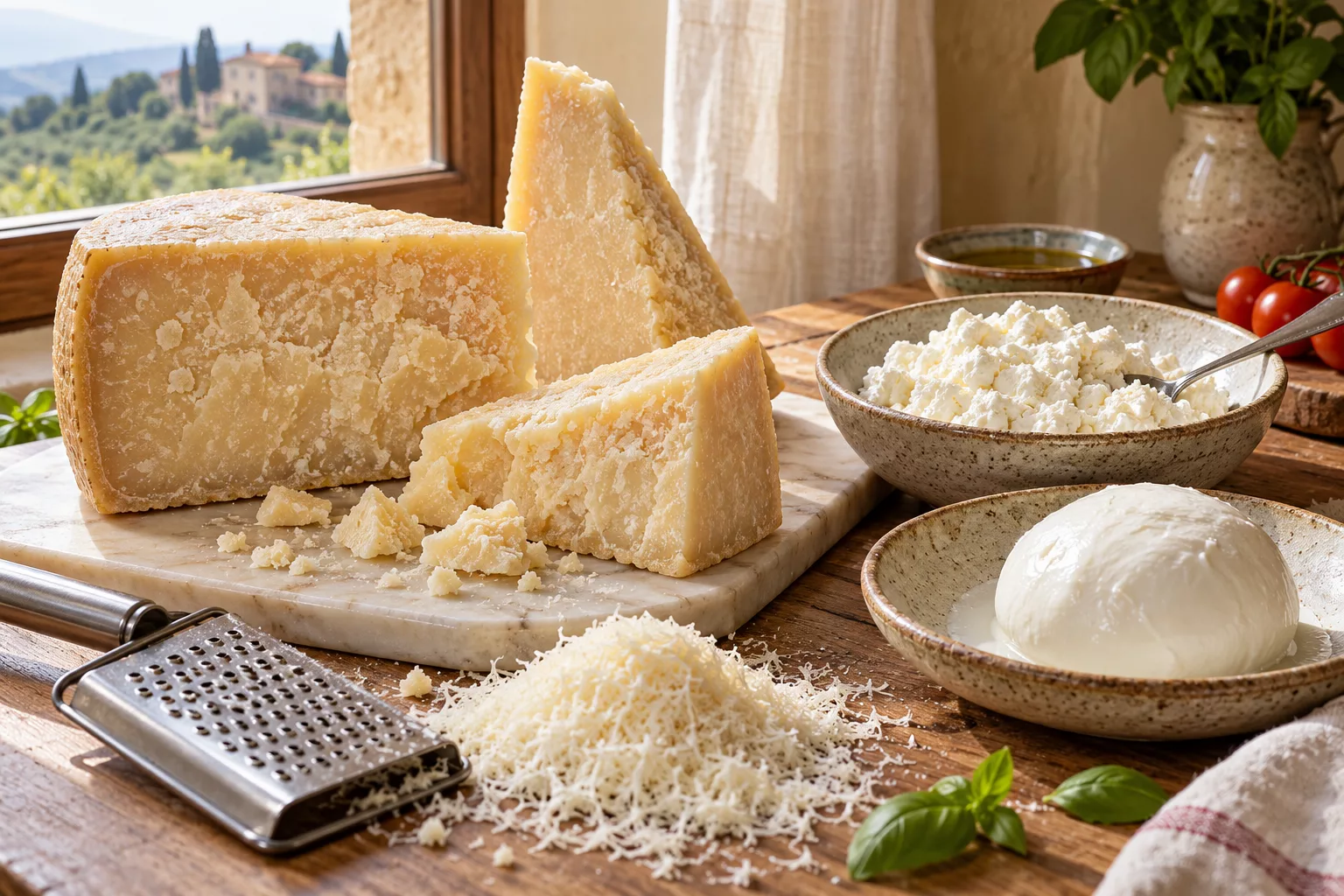
Parmigiano Reggiano: depth and a granular bite
Parmigiano Reggiano is a hard cow’s-milk cheese with PDO (protected designation of origin) status, made under a defined specification and matured for at least 12 months. Its ingredients are milk, salt, and calf rennet. Different ages offer different balances of texture and aroma, so two wedges need not taste identical.
For pasta, grate it finely when you want it to disperse through a warm dressing; use shavings when distinct pieces are part of the finish. A small quantity can deepen a vegetable or meat sauce without turning it into a visibly cheesy dish.
Do not choose solely by the longest ageing number. A very mature cheese can be assertive where a gentler one would leave more room for the sauce. Start with the recipe’s suggestion or a wedge whose flavour suits the other ingredients.
Grana Padano: a separate cheese, not a grade
Grana Padano PDO is another hard, granular cow’s-milk cheese, with its own production rules and a minimum ageing period of nine months. It is not simply a younger category of Parmigiano Reggiano, even though the two can occupy similar places in a kitchen.
It can provide a savoury grated finish or contribute to a dressing. Taste the particular wedge rather than relying on a promise that it will always be milder. Age, producer, and the quantity used affect how much presence it has in the dish.
Some Grana Padano contains lysozyme derived from egg white; the consortium notes exceptions such as Trentingrana. Check the actual ingredient and allergen label, particularly when cooking for someone with an egg allergy. Do not assume a hard cheese contains only milk-related allergens.
Pecorino Romano: account for its salt and sharpness
Pecorino Romano PDO is made from sheep’s milk. Its defined production area includes Sardinia, Lazio, and the province of Grosseto in Tuscany. The name therefore should not be read as a promise that every wheel was made within the city of Rome.
It offers a salty, assertive character that can be central to a dish rather than a quiet background seasoning. When replacing a cow’s-milk grating cheese with it, begin with less and taste. Reduce other salt additions until you know what the cheese contributes.
“Pecorino” describes a broader family of sheep’s-milk cheeses, not one interchangeable product. A young, soft pecorino will not behave like an aged grating Pecorino Romano. Read the complete name and choose the maturity and texture appropriate to the preparation.
Fresh cheeses do different work
Fresh ricotta adds a mild, soft texture to fillings and dressings. It does not melt into elastic strands like mozzarella. Loosen it gently if using it as a coating, and expect a different mouthfeel from a sauce based on finely grated aged cheese.
Ricotta salata is a firmer, salted product used differently, including as a grated or crumbled finish. It is not a spoon-for-spoon replacement for fresh ricotta. If a recipe specifies one, check that you have bought the right form.
Mozzarella is useful when a dish wants soft melted pieces or stretch, especially in baked pasta. Fresh mozzarella also brings moisture; drain it as the recipe directs rather than assuming all mozzarella products behave the same. Choosing an aged cheese for flavour and mozzarella for texture can be purposeful, but piling both on every dish is not necessary.
Grate and add with intention
Fine, even grating helps a hard cheese disperse. Large shreds take longer and can remain in clumps, particularly if the sauce is too dry. Grate before the pasta reaches its endpoint so you can work calmly during the finish.
For a dressing built from grated cheese and liquid, high heat is not automatically helpful. Move the pan off the burner as the method requires, add cheese gradually, and keep enough moisture for it to spread. A dry pan plus a large handful of cheese is a common route to sticky lumps.
The pan-finishing guide explains how to coordinate pasta, sauce, and final additions. It is better to prevent a tight, overheated dressing than to promise that another ladle of water will rescue every broken one.
Season the whole dish, not each part blindly
Cheese and salted cooking water both contribute seasoning. Keep the sauce slightly restrained until they meet, especially when using Pecorino Romano or another assertive grating cheese. Taste a dressed bite before adding more salt.
For pesto, cheese belongs to a combination of herbs, oil, nuts, and seasoning; changing it can shift the entire balance. In a meat sauce such as ragù, a grated finish may complement rather than dominate. Some preparations need no cheese at all.
When substituting, think in terms of flavour and function, not an automatic equal weight. A milder cheese may need a different quantity, but adding more also changes moisture, fat, and sauce thickness. Make small adjustments and accept that the result is a variation.
Cheese-counter questions
Are these cheeses vegetarian?
Do not assume so. Parmigiano Reggiano and Grana Padano use calf rennet under their specifications. If animal rennet is unsuitable, look for a clearly labelled alternative made with suitable coagulants and recognise it as a substitute.
Is pre-grated cheese unusable?
No. Check its ingredients and intended use. Freshly grating a wedge gives you control over size and makes comparison easier, but convenience products vary. Expect their behaviour to depend on the actual product rather than a blanket rule.
Should cheese go on every pasta dish?
No. It can overwhelm delicate flavours or change a carefully balanced sauce. Taste first and follow the preparation you are making. Leaving cheese off can be as deliberate a decision as choosing a particular wedge.