A strand bends freely and feels firm when bitten, with no hard white core. It should not be soft before the off-heat finish.
Pasta recipe
Spaghetti
al Limone
Bright lemon aroma held in a glossy coating of butter, olive oil, Parmigiano, and starchy pasta water—not a heavy cream sauce.
Editorial draftThis recipe has not yet been kitchen-tested by PastaBible.
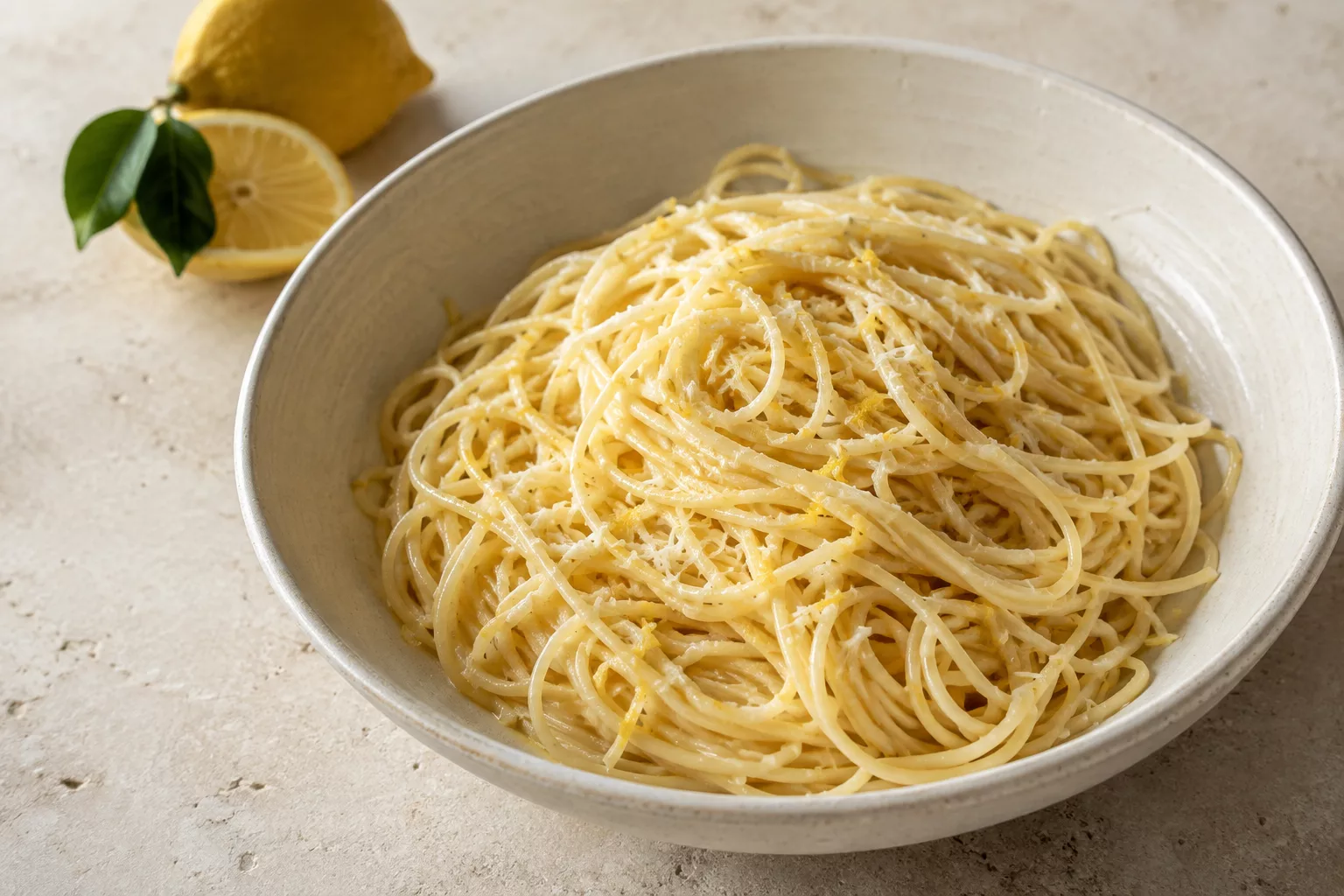
The version here
One coherent method, not a universal formula
Italian pasta al limone appears in multiple forms: some use butter, some olive oil, some cheese, and others cream or a lemon-infused cooking liquid. Documentation does not support treating one modern formula as the single definitive version for every region.
This PastaBible draft chooses a butter-and-Parmigiano emulsion. Zest supplies volatile lemon aroma without much acidity; juice sharpens the finished sauce. Keeping those jobs separate lets the zest perfume the fat gently while the juice enters only after the cheese emulsion is stable.
Method
Control heat, then add acid
Have everything measured before the spaghetti leaves the water. The emulsion comes together quickly and should not wait.
- 01
Prepare every finishing ingredient
5 minFinely grate the yellow zest from both lemons, avoiding the bitter white pith. Measure 45 ml (3 tbsp) juice; keep it separate from the zest. Grate all 80 g (2.8 oz) Parmigiano as finely as possible. Divide the butter into two 30 g (2 tbsp) portions.
- 02
Cook the spaghetti short of done
8–10 minBring 3 L (3 qt) water to a full boil and dissolve in all 18 g (1 tbsp) salt. Add 320 g (11.3 oz) spaghetti and stir through the first minute. Cook until about 3 minutes shy of the package time. Before transferring the pasta, reserve 360 ml (1½ cups) cooking water.
- 03
Build the aromatic base
1 minWhile the pasta cooks, put the olive oil, 30 g (2 tbsp) butter, and three-quarters of the lemon zest in a wide pan over low heat. Swirl only until the butter melts and the zest smells fragrant, about 30 seconds. Do not brown the butter or fry the zest.
- 04
Finish the spaghetti in water and fat
2–3 minTransfer the very al dente spaghetti to the pan and add 180 ml (¾ cup) reserved pasta water. Raise the heat to medium and toss continuously until the strands bend easily but still resist at the center. The liquid should look slightly thickened and mobile, not dry. Remove the pan from the heat.
- 05
Emulsify away from direct heat
2 minWait 30 seconds, then toss in the remaining 30 g (2 tbsp) cold butter. Add the 80 g (2.8 oz) Parmigiano in three additions, tossing vigorously after each. Add reserved water 15–30 ml (1–2 tbsp) at a time until the cheese, butter, oil, starch, and water form a glossy coating. If the pan hisses or the cheese clumps, it is too hot—keep it off the burner and add a little warm water.
- 06
Add acidity and serve immediately
1 minMix 30 ml (2 tbsp) lemon juice with 30 ml (2 tbsp) reserved pasta water. Toss it into the spaghetti in two additions. Taste; add the remaining 15 ml (1 tbsp) lemon juice only if the sauce needs more acidity. Finish with the remaining zest and all 1 g (½ tsp) black pepper. The sauce should flow around separate strands; loosen once more with water if it tightens before serving.
Kitchen checkpoints
What to see and feel
Glossy and fluid enough to move when the pan is tilted. No puddle of clear butter or strings of clumped cheese.
Fragrant first, tart second. The sauce should taste bright without becoming sharply sour or masking the cheese.
Failure points
How to bring the sauce back
The cheese clumps
The pan was too hot or the cheese went in too quickly. Keep it off heat, add 15 ml (1 tbsp) warm pasta water, and toss. Repeat once if needed; do not boil.
Butter pools in the pan
The fat needs more water and movement. Add 15–30 ml (1–2 tbsp) warm pasta water and toss hard until the liquid turns opaque and coats the strands.
The sauce becomes thin
Too much water entered at once. Keep tossing off heat for 20–30 seconds; starch and cooling cheese will tighten it. Add future water by the tablespoon.
The lemon dominates
Prevent this by adding the last tablespoon of juice only after tasting. If already too sharp, loosen with a little pasta water and a small extra knob of butter; do not try to hide it with sugar.
Clearly marked variations
Change one variable at a time
More assertive cheese
Replace 20 g (0.7 oz) of the Parmigiano with 20 g Pecorino Romano and reduce the cooking-water salt from 18 g to 15 g (from 1 tbsp to about 2½ tsp). The sheep’s-milk cheese makes the finish sharper and saltier.
Olive-oil-forward
Use 30 g (2 tbsp) butter total and increase the olive oil to 60 ml (4 tbsp). Add the extra oil gradually during the off-heat toss; expect a lighter dairy flavor and a slightly looser coating.
Fresh herbs
Fold in 10 g (about ½ cup loosely packed) torn basil or flat-leaf parsley only after the emulsion is complete. This is an optional aromatic variation, not part of the primary method.
Storage & reheating
Best fresh; handle leftovers promptly
The emulsion is at its best immediately. If saving leftovers, FoodSafety.gov advises refrigerating cooked food within two hours in a shallow container and using it within four days.
For reheating, add a small splash of water, cover, and heat in short intervals, stirring between them, until the leftovers reach 165°F / 74°C. The sauce may not return to its original gloss; strong direct heat is more likely to split it. Freezing is safe when properly handled, but is not recommended here because the pasta and emulsion lose quality.
Explore the connections
Understand the strand and the emulsion
Ingredient quantities, timing, and sensory checkpoints are an editorial working draft. PastaBible has not yet kitchen-tested this recipe; it should be cooked repeatedly before the draft status is removed.