PastaBible Ingredients guide
Fresh Pasta vs. Dried Pasta
Fresh pasta is not automatically an upgrade over dried pasta. They offer different textures, suit different preparations, and demand different timing. A tender egg ribbon can be wonderful with a carefully balanced dressing; a firm dried tube can be exactly what a substantial sauce needs.
The useful comparison begins with ingredients and structure. “Fresh” does not necessarily mean egg pasta, and “dried” does not necessarily mean egg-free. Read the packet or ask the maker, then choose according to the dish rather than the prestige of the label.
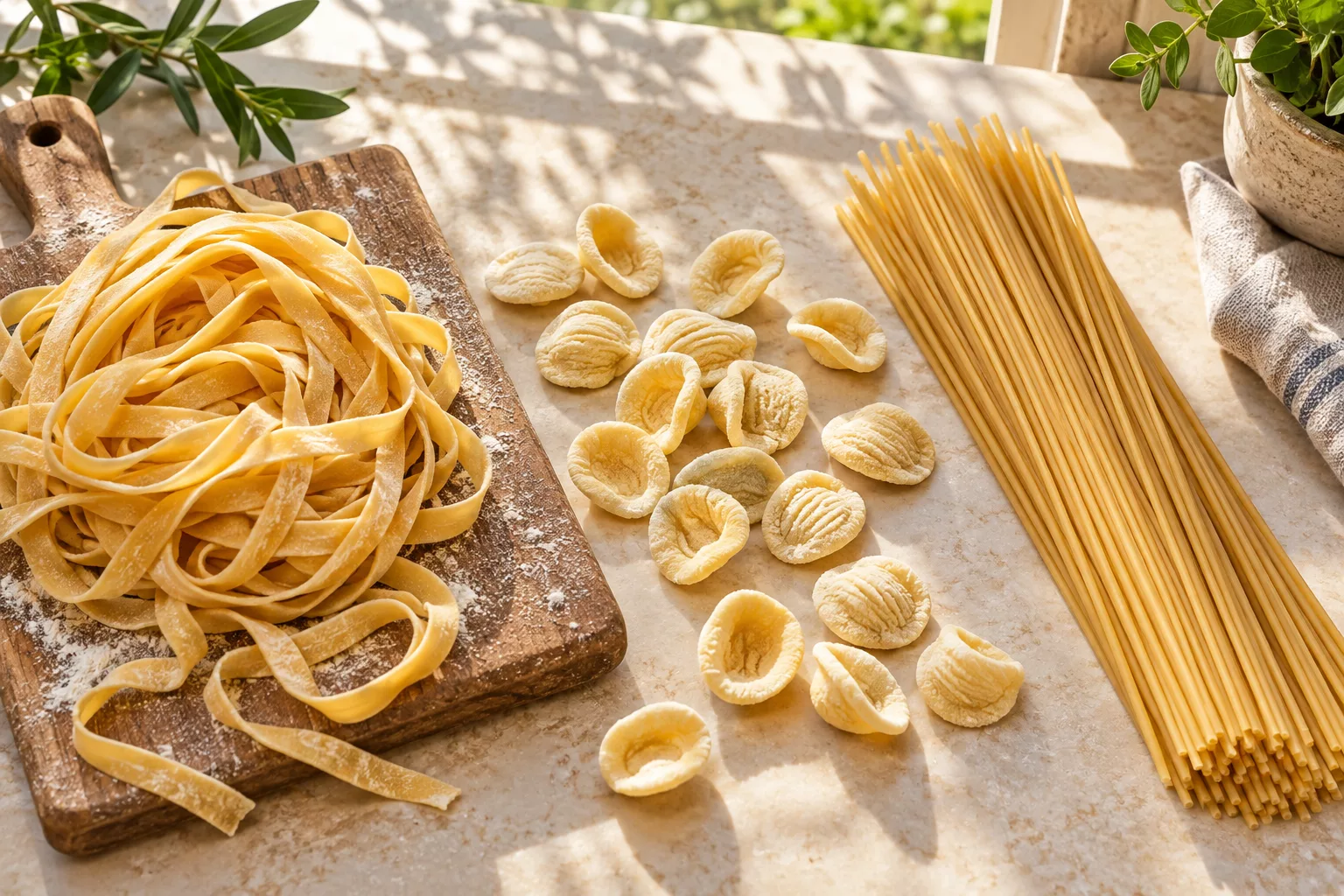
Separate three everyday categories
Fresh egg pasta commonly combines wheat flour and eggs, sometimes with other ingredients depending on the dough. It can be rolled into sheets, cut into ribbons, or used to enclose fillings. Thickness and handling help determine whether the cooked result feels delicate or substantial.
Fresh water-and-semolina pasta is a different family. Handmade shapes such as many Puglian orecchiette are made without eggs. Freshness here does not imply the rich taste of egg dough; the appeal can be the wheat flavour, surface, and shaped bite.
Much ordinary dried Italian pasta uses durum wheat semolina and water, formed and dried into a stable product. Dried egg pasta also exists, including ribbons. Gluten-free and other formulations add further variation. These categories overlap in appearance, so a yellow colour or a familiar shape name cannot tell the entire story.
Expect different textures
Fresh egg ribbons often cook to a supple, tender texture. Their attraction is not necessarily a hard central bite. A thicker handmade semolina shape can feel more robust, even though it is also fresh. Dried wheat pasta commonly provides the firm, springy resistance associated with al dente.
Those are tendencies rather than guarantees. A thick fresh noodle can need more cooking than a very thin dried one. An overcooked premium product will still be overcooked. Judge the particular pasta, including its thickest section, instead of treating either category as foolproof.
When comparing two products, think about what you want on the fork. Do you want the noodle to fold softly around a sauce, or to keep a distinct structure beside it? Neither answer is inherently more refined.
Choose the sauce with the pasta
Fine egg ribbons can suit butter-based dressings, delicately textured sauces, and suitable ragù preparations. The sauce needs enough fluidity to separate the ribbons without overwhelming them. A fresh pasta that tastes good by itself deserves a dressing that leaves some room for that flavour.
Dried spaghetti offers a different experience with smooth tomato or olive-oil dressings. Sturdy dried tubes can accompany chunkier sauces. Fresh semolina cups or folds can gather vegetables and small pieces while maintaining their own character.
A general rule such as “fresh for cream, dried for tomato” is too narrow. Look at the thickness, shape, and sauce consistency together. The pairing guide explains how to make a substitution without pretending the result will be identical.
Change the cooking sequence
Many fresh pastas cook quickly enough that the sauce and serving setup should be ready before they go into the water. Separate pieces gently, follow the maker’s instructions, and keep an eye on the pot. Do not plan a long sauce reduction after fragile ribbons are already cooked.
Dried pasta often gives you a longer cooking window, but that is not permission to ignore it. Start tasting near the stated endpoint and decide how much further cooking the sauce stage will provide. A packet of dried egg ribbons may need different handling from a robust durum tube.
Floating is not a universal doneness test for fresh or filled pasta. Check the product’s directions and the thickest part of the wrapper or shape. For filled pasta, the filling is part of the cooking requirement too; do not use a plain-noodle shortcut.
Buying quantities and making substitutions
Fresh pasta already contains more moisture than a comparable dried product, so equal uncooked weights do not necessarily provide equal amounts of pasta solids or the same cooked portion. Filled pasta adds another variable because some of its weight is filling.
Use the portion guidance for the product or the recipe you are following. When substituting, consider appetite, accompaniments, and how substantial the sauce is rather than using one universal conversion. Keep some sauce back until you see how the cooked portion and coating balance.
For a first attempt at a dish, the specified pasta is the easiest baseline. If you change it, adjust the timing and handling deliberately. A sauce designed to finish with sturdy dried pasta may need to be fully ready before delicate fresh pasta joins it.
Storage labels matter more than appearance
Follow the package’s storage and use-by instructions. Some products sold as fresh require refrigeration, while specialised sealed products can have different storage conditions. Do not assume that a fresh-looking noodle is safe at room temperature because a neighbouring packet was shelf-stable.
Homemade dough deserves the same care as other raw foods. The FDA advises against tasting raw flour or dough, including egg-free dough, because flour itself can carry harmful bacteria. Keep raw flour and eggs away from ready-to-eat food, and clean hands, tools, and work surfaces after preparation.
Drying homemade pasta until it feels firm is not proof that it has become equivalent to a commercially shelf-stable product. Use a reliable preservation method rather than improvising storage from appearance. This comparison is about choosing pasta for cooking, not a home drying or preservation procedure.
Common assumptions to leave behind
A higher price, a refrigerated shelf, or a handmade description does not guarantee a better match for tonight’s sauce. Likewise, a simple dried pasta can be a deliberate choice rather than a compromise. Buy a product you can use well and cook it attentively.
If your fresh pasta tears, gentler handling may be more useful than a different sauce. If your dried pasta tastes dull, check seasoning and doneness before dismissing the category. Product quality matters, but so does what happens in your kitchen.
Shopping questions
Is fresh pasta always vegetarian?
No. Fillings can contain meat or cheese made with animal rennet. Read the full ingredient list rather than judging the wrapper alone. Egg-free also does not automatically mean free from every animal ingredient.
Can dried pasta contain eggs?
Yes. Dried egg pasta is an established product category. Check ingredients and allergen information, especially if you usually buy plain semolina-and-water pasta and are changing to ribbons or another range.