Pasta Bible · Sauces
Walnut Sauce: A Guide to Ligurian Salsa di Noci
Ligurian salsa di noci is a pale, savoury walnut dressing often served with pansoti, filled pasta traditionally associated with greens. The sauce should settle into the folds of each parcel. Soften bread in milk, crush the walnuts gently and loosen the mixture just before dressing the pasta. A little fine grain feels pleasant against the smooth wrapper. If the sauce holds the shape of a spoonful like nut butter, it needs moisture.
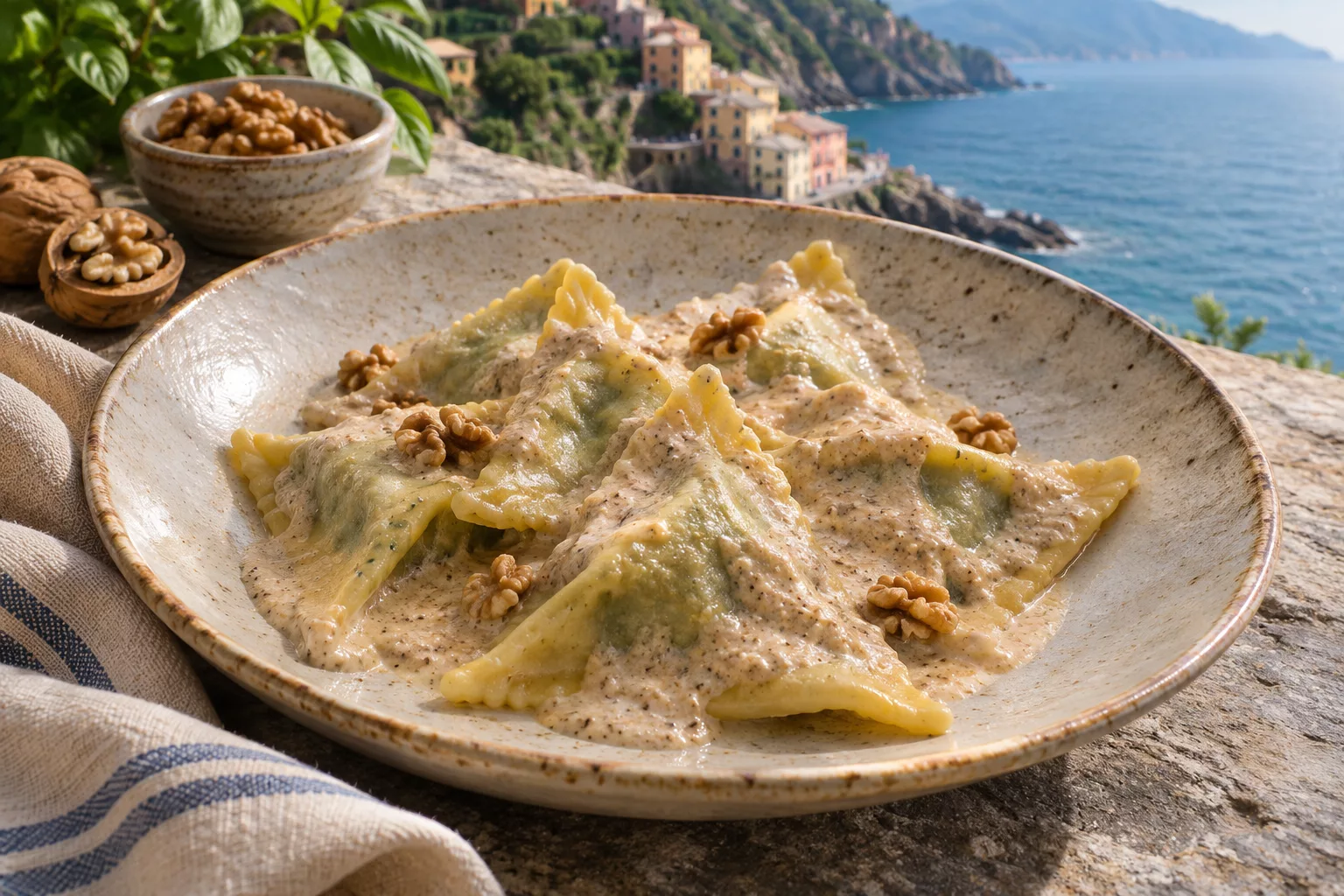
The sauce on a Genoese plate
In and around Genoa, walnut sauce has a particularly close association with pansoti, also written pansotti. The soft filling of greens and fresh dairy gives each mouthful a gentle tang or herbal note. Walnut has enough character to accompany that filling without hiding it behind tomato or meat. Local accounts also pair the sauce with chestnut gnocchi, whose sweetness brings out a different side of the nut.
There is more than one Ligurian formulation. The city of Genoa describes one with milk-soaked bread, garlic, grated cheese and prescinsêua, a local fresh curd. A version documented by the Genoa Chamber of Commerce from the restaurant Manuelina also builds on walnuts and softened bread. Such examples place the dressing in a regional kitchen without giving every household the same shopping list. A precise account of who first made it is harder to establish.
Walnut sauce shares the mortar with pesto Genovese, and both can be loosened to dress hot pasta. In basil pesto the herb provides much of the aroma and colour. Here the walnut itself provides the main flavour and much of the body. Substituting walnuts for pine nuts in a green basil dressing produces a variation on pesto with a quite different taste from salsa di noci.
Taste one kernel before reaching for the mortar
Fresh-tasting walnuts have a mild sweetness behind their slightly bitter skin. Taste one plain. A stale, rancid flavour will remain in the finished sauce no matter how much milk or cheese goes in. For a very pale, mild dressing, blanch the kernels briefly, then rub or peel away the loosened skins. Leaving some skin gives a more speckled appearance and a firmer edge to the flavour.
Browning nuts in the oven, useful for many dishes, is a deliberate change here. Toasted kernels make a darker, roast-flavoured sauce. For the delicate dressing that goes with herb-filled pansoti, begin with unroasted walnuts so you can taste the milky softness of the bread alongside them. Reserve a few slivers for the top only if you want that extra contrast.
Bread gives the walnuts somewhere to go
The soft interior of a plain loaf readily takes up milk. Once it yields under your fingers, squeeze it gently. It should retain moisture without dripping. A hard crust can leave chewy flecks that stand out from the walnut grain. Start with some of the softened bread, then add more to taste. Too much creates a smooth but anonymous dressing that needs a surprising amount of seasoning.
Crush a little garlic finely before combining it with the kernels. A large raw fragment tastes much stronger than the same amount spread through a bowl. Finely grated cheese adds savour and salt. Olive oil rounds out the mixture, but an extra pour is rarely the best way to loosen a stiff sauce. The walnuts already contain plenty of oil. What the bread and ground nuts often need is liquid.
Crush, pause, then adjust
A mortar lets you feel when the pieces have broken down. In a processor, pulse and scrape the sides between bursts. Once the kernel pieces are small, work in the soft bread and dairy and assess the mixture again. Running the blades continuously on dry walnuts encourages the oil to come out and can take the mixture towards nut butter. A few tiny irregular fragments are welcome.
Spoon some dressing into a wide serving bowl. Stir in a little warm cooking water until a spoon drawn through it leaves a trail that slowly closes. Add the drained pasta, fold gently and see how the sauce behaves between the pieces. The dressing left in the mixing bowl can be added as needed. A hard boil in a frying pan risks both drying out the bread and losing the delicate fresh character.
Serving a table with allergies
Walnuts are a tree nut and are present throughout this sauce, even when the surface is perfectly smooth. Choose a different dressing for someone with a walnut allergy and prepare their portion with clean, separate utensils. Picking off chopped nuts cannot remove ground walnut. The bread, milk, cheese and filled pasta may introduce wheat, milk or egg as well. Check the actual ingredients of each component with your guest.
Walnut sauce questions
What can I dress if I cannot find pansoti?
Spinach and ricotta ravioli make a practical pairing. Look for a filling you would enjoy with walnuts on its own. For an unfilled pasta, try ribbons with a slightly looser dressing so it can travel their length. Our Liguria guide gives more context for the region's filled and shaped pasta.
Why is the dressing clinging in patches?
It probably went onto the pasta too thick or too cold. Lift a spoonful of dressing into the side of the bowl and mix in a little warm water, then gently turn the parcels through it. This disperses the liquid more evenly than pouring a large splash over the top of fragile pasta.
Does the sauce need cream?
No. Soaked bread, ground walnuts and a little cooking water can produce a soft, creamy texture, with cheese or curd adding another layer of flavour in some versions. If you use cream as a variation, add it sparingly and taste a dressed piece before adding more. The walnut should still be the first thing you recognise.