PastaBible Ingredients guide
What Is Durum Wheat Semolina?
Durum wheat semolina is a milled wheat product widely used to make pasta. “Durum” identifies the wheat; “semolina” describes a milling product, generally with a coarser texture than ordinary fine flour. They are not competing ingredients, and a packet listing both words is not naming two separate grains.
For a home cook, the most useful details are the wheat type, how finely it has been milled, and what the product is intended to make. Those details help explain why one bag works comfortably in a dough while another feels gritty or behaves differently.
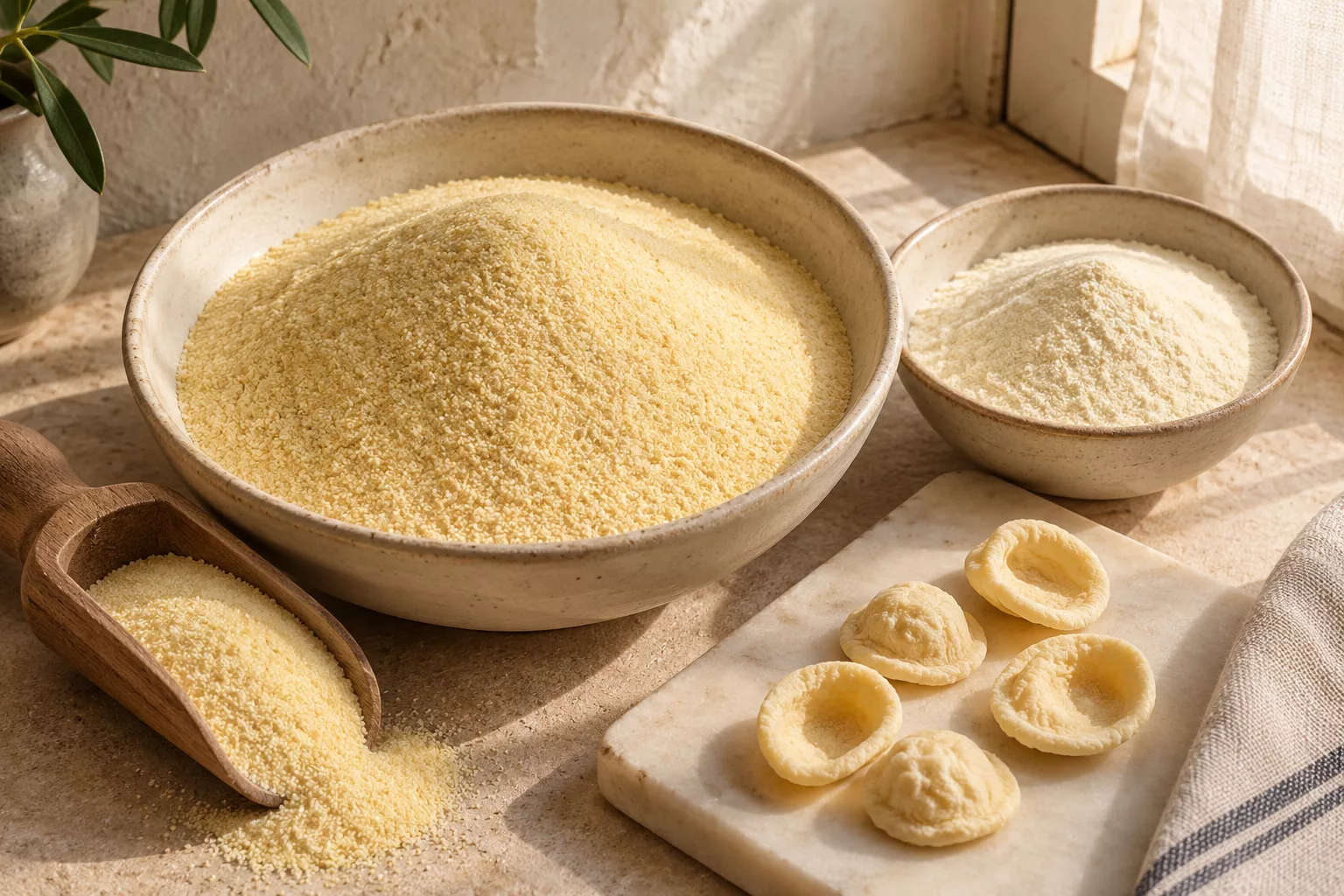
Start with the grain and the grind
Durum is a type of wheat with a hard kernel. Semolina for pasta is made by milling that wheat into particles that are typically coarser than those in a finely milled flour. It is often pale yellow and contains gluten-forming proteins.
Durum can also be milled more finely. English-language products may use terms such as durum flour or semolina flour, and naming is not perfectly consistent across markets. A bag called semolina flour may still have a noticeably granular feel. Read the maker’s description rather than expecting the word “flour” to guarantee one texture.
Look for the full phrase “durum wheat” when buying for a recipe that requires it. Products sold for puddings or porridge under a broad semolina label may differ in wheat type or particle size. Similar-looking grain products are not automatically interchangeable in pasta dough.
Why it suits pasta
When wheat flour or semolina is mixed with water and worked into dough, its proteins help form a gluten network. Alongside starch, that structure contributes to how pasta holds together and feels when cooked. Durum semolina is valued for pasta with a distinct, resilient bite.
The finished texture is not determined by the ingredient name alone. Milling, hydration, mixing, shaping, and drying all play a part. A short ingredient list can still produce different results from different makers. Nor does a high protein number by itself promise that every dough will handle well.
For the eater, the practical test remains the cooked pasta. Does the shape keep its form? Is the bite pleasant rather than brittle or mushy? Does the surface take the sauce well? The label gives useful clues, but it does not replace cooking and tasting the product.
What semola rimacinata means
On Italian packaging, semola di grano duro means durum wheat semolina. Rimacinata means remilled: the semolina has been milled again to produce a finer product. That finer texture can be convenient when mixing a smooth dough by hand.
Do not assume every recipe that says semolina means the same grind. A recipe developed around a coarse product may need a different approach from one using remilled semola. Follow the named flour where possible, especially for your first attempt.
If the shop carries several bags, compare intended uses and descriptions. A product explicitly suggested for fresh pasta is a clearer starting point than an unlabeled bulk ingredient. De Cecco, for example, describes its remilled durum product for pasta with or without eggs as well as other uses.
How it differs from ordinary wheat flour
Common all-purpose and plain flours are generally milled from other wheat types and have their own handling characteristics. They can be useful in egg pasta, alone or in a blend specified by a recipe. They are not simply inferior semolina.
Likewise, an Italian “00” label should not be read as another name for durum semolina. A product labelled for pizza and one labelled for fresh pasta may be intended for different jobs. Read the wheat and product description instead of treating the number as a universal pasta quality score.
If a recipe calls for a particular blend, substituting every flour with semolina changes more than colour. The dough may need a different hydration level, resting time, or handling. Use a recipe designed for the flour you have rather than repeatedly adding liquid to an unfamiliar dough without a reference.
Choose according to the job
For handmade water-and-semolina shapes, look for a suitable durum product and a method that names its grind. Many fresh orecchiette belong to this family. They illustrate why semolina is relevant to fresh pasta as well as dried packets.
For fine rolled egg sheets, a recipe may favour another wheat flour or a blend. The aim is a sheet that rolls and seals as intended, particularly for filled pasta. The fresh and dried pasta guide separates these dough families.
For dusting a work surface or tray, use only as much as the method needs. A heavy layer can cling to the pasta and change the cooking water. Dusting flour is not a substitute for adjusting a dough that is too wet, and excessive dusting can make a delicate sheet harder to seal.
Handle a new flour methodically
Measure by weight when following a dough formula. A cup of coarse semolina and a cup of a finer flour need not weigh the same, so changing both the product and the measuring method creates avoidable uncertainty.
Give the dough the rest called for in the recipe before judging it solely by the first rough mixture. Additions made too quickly can leave you chasing a texture that would have improved with time. Keep the unused flour clearly labelled so the next attempt starts with the same ingredient.
Follow the storage directions on the bag and keep it protected from moisture. Treat flour as raw food: do not taste uncooked dough to assess whether it is ready. Cooking, rather than the absence of eggs, is the relevant safety step for flour-based foods.
Flour-label questions
Is semolina gluten-free?
Durum wheat semolina is wheat and contains gluten. It is not a substitute for a product specifically formulated and labelled gluten-free. A coarse texture does not change its wheat identity.
Is semolina the same as polenta?
No. Polenta is associated with maize, while the semolina discussed here is durum wheat. Their colour and granularity can look similar, but they do different jobs in pasta dough. Check the grain named on the packaging.
Does yellow pasta necessarily contain eggs?
No. Durum products can be naturally yellow, and colour alone cannot identify a dough’s ingredients. Use the ingredient and allergen declarations instead, especially when buying unfamiliar pasta.