Pasta Bible · Ingredients
Capers in Pasta Sauces
Capers are unopened flower buds, cured to develop the flavour that gives a pasta sauce its little bursts of salt and tang. Taste a drained bud before seasoning the pan. Brined capers may be ready to use straight away, vinegar-packed ones bring extra acidity, and salt-packed buds usually need rinsing and a short soak. For flavour throughout the sauce, chop a few. For a distinct bite, leave some whole.
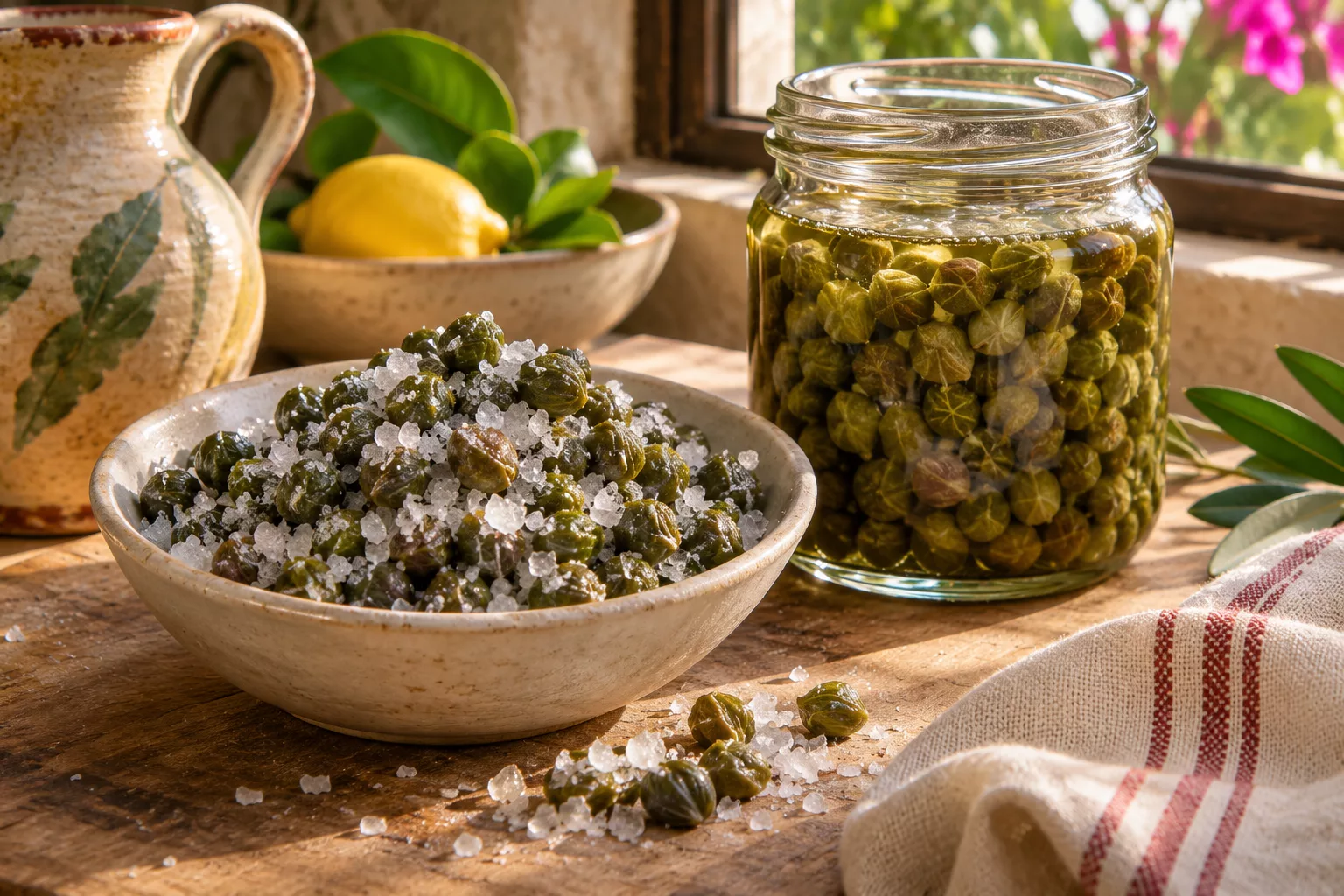
What is actually in the jar?
Look closely and you can see the folds of a small bud. The colour ranges from olive green to a darker green-brown. Size affects the eating experience as much as it affects appearance. Small buds scatter through a forkful of spaghetti, while larger ones offer enough surface to chop without losing their identity. The most useful size depends on whether you want seasoning in every bite or something to find between the strands.
Caper berries develop after the plant flowers. They are larger, often sold with a stem attached, and contain small seeds. In Sicily you may hear them called cucunci. A berry makes a good accompaniment to a plate of antipasti. A whole one in a delicate pasta sauce gives quite a different mouthful from a bud. If berries are all you have, remove the stems, slice the fruit and taste a piece before deciding how much to add.
Salt, brine and vinegar on the label
Salt-packed capers often arrive nestled in coarse crystals. The buds give off moisture as they cure, so a little liquid in a salty pack makes sense. Tip the portion you need into a sieve and shake away the loose crystals. Rinse under cool water, then taste. If the centre is still too salty, soak the portion in fresh water and taste again. Stop when the flavour is pleasantly assertive. Leaving them soaking indefinitely can strip away much of their character.
Brined capers sit in a liquid containing salt and water. Drain a spoonful well. If both sauce and buds are mild, use them straight from the sieve. If the dressing includes anchovy or seasoned olives, a rinse gives you more room to manoeuvre. Read the label even when the front says brined. Some packing liquids contain vinegar as well, and the sourness may be quite distinct from the salt.
Vinegar-packed capers can be welcome in a mild, buttery dressing where a little sharpness is the point. Try a bud alongside a spoonful of your sauce. If the tomato is already tangy, rinse and drain them before adding more. Spoon buds out of the jar separately from the liquid. That gives you the option of adding a few drops of vinegar later without committing the entire pan to the flavour of the pickle.
One spoonful, three textures
A whole drained caper holds a small reserve of flavour within its folds. Add it towards the end for a more pronounced bite, or let it simmer briefly so it shares some seasoning with the surrounding tomato. Crush a few with the side of a knife for a middle ground. Roughly chopped buds are particularly useful in oil-based sauces, where the little pieces can travel with the oil along a strand of pasta.
For a crisp finish, dry rinsed buds very thoroughly between towels. Put a small batch in a shallow layer of hot oil, leaving room between them. Wet capers spit and cool the oil. Lift them out when the folds open and the edges turn crisp, then drain them. They can go bitter if fried until uniformly dark. Taste one before adding salt to the garnish. Its seasoning has just been concentrated.
Treat fried capers like toasted breadcrumbs and scatter them at the end. If you stir them into a wet sauce early, the folds soften again. A few crisp buds on top of soft noodles give more contrast than a large amount mixed in. If you are after seasoning alone, skip the frying and put the chopped buds straight into the sauce.
Put the tomato, olive and caper in the same bite
In puttanesca, an olive contributes flesh and a caper contributes a smaller, sharper accent. Taste the olives and capers together. If both are highly salted, prepare the capers more thoroughly and hold back salt in the tomato. If one is mild, allow the other to stand out. Taste with the pasta too. A plain strand changes how intense the sauce feels in the mouth.
Away from tomato, a little chopped caper works well in olive oil with parsley or in warm butter over ribbons. Choose one main source of acidity first. Lemon juice, wine vinegar and vinegar-packed capers can each seem like a modest addition, yet together they can overwhelm a mild dressing. Add lemon zest if you want fragrance before deciding whether the juice belongs there too.
Caper questions
Do I need to rinse the whole jar?
Take out only what you intend to use. The packing medium belongs with the remaining buds, and the jar has its own storage directions. Rinsing a spoonful lets you adjust it to today's dish. Tomorrow's sauce may call for a different balance of salt and sharpness.
What if I have added too much caper liquid?
If the sauce is now thin and salty, boiling it down will concentrate the salt. Extend a tomato sauce with unsalted tomato, or dress more pasta and distribute the seasoning across the larger portion. If it is the vinegar that stands out, a little olive oil can soften the impression, but taste again on the pasta.
Can olives stand in for capers?
Chopped olives can supply salt and a briny accent. They bring more flesh and a different aroma, so do not expect the same bright, concentrated burst. For a dish that already contains olives, it may be more satisfying to let them carry the sauce than to double the quantity in an attempt to imitate the missing buds.